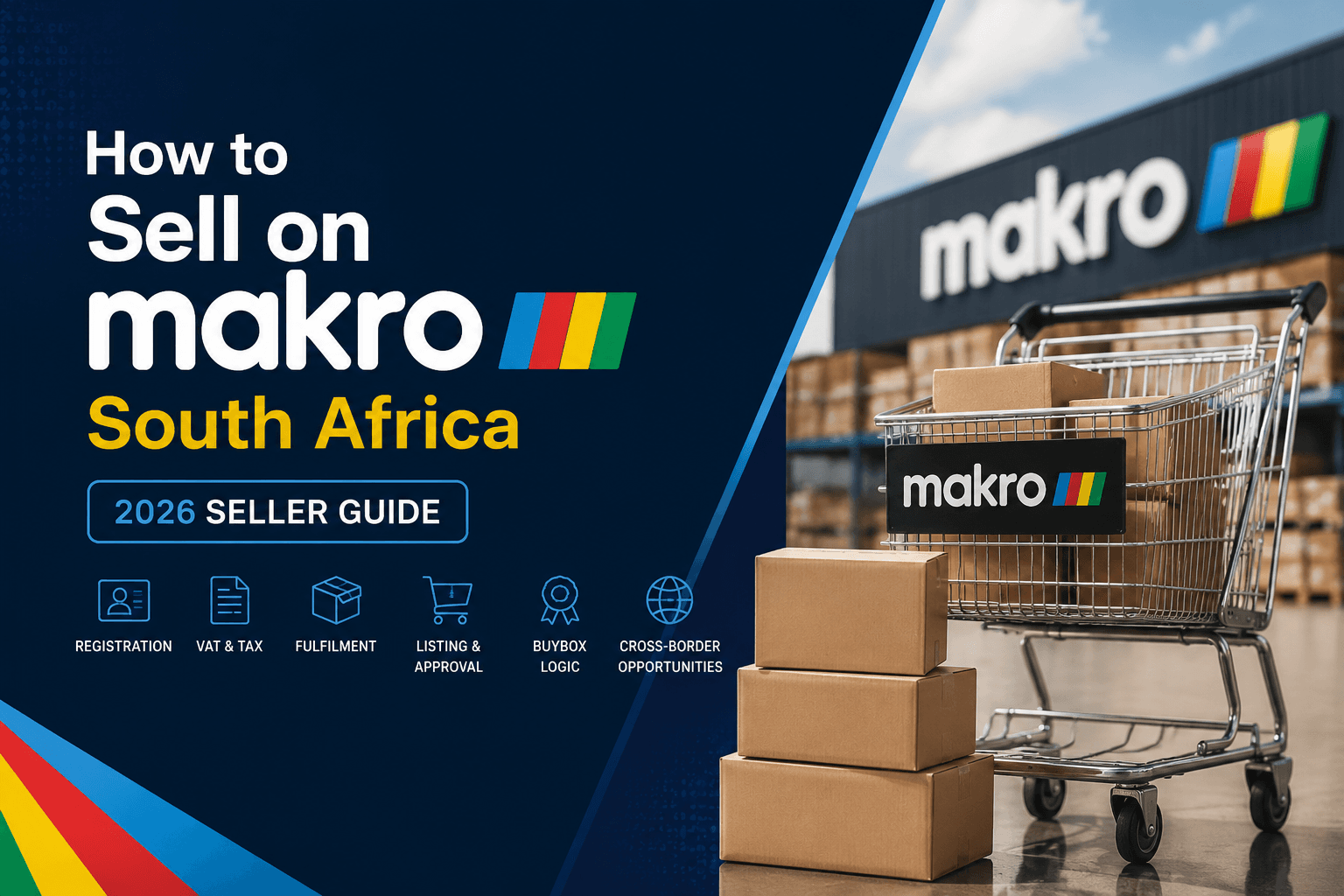
How to Sell on Makro South Africa in 2026: Complete Seller Guide
Note: I checked the public Makro help-centre pages, seller-facing ecosystem pages, and community discussions on 2026-05-08. Where newer help-centre articles and older PDFs disagree, this guide follows the newer help-centre article first.
Makro is no longer just a retail website with a marketplace layer bolted on. Its own terms say third-party sellers can list products on the site, and the sale is between the customer and that seller, not Makro itself. That makes the channel worth studying, but also worth treating like a real operating model rather than a quick listing experiment.
The right question in 2026 is not "Can I open a Makro account?"
It is "Can my business survive the fee stack, the fulfilment rules, the approval checks, and the Buybox pressure?"
This guide is written for sellers who want the answer in plain language.

Quick verdict
Makro is worth considering in 2026 if you already have local stock, clean product data, and a South African operating setup. It is not a good fit if you depend on long cross-border lead times, thin margins, or sloppy catalogue data.
Suitable sellers
- South African sellers with local stock and a real fulfilment process
- Wholesalers and brand owners with clean product data and stable inventory
- Sellers who can hit a short pick/pack SLA without improvising
- Businesses that want a second channel beside Takealot
- Sellers who can handle returns, claims, and customer follow-up without drama
Unsuitable sellers
- Direct-export sellers who want to ship every order from China
- Sellers whose margins disappear once fulfilment and return fees are added
- Used, refurbished, or second-hand product sellers
- Catalogues full of weak images, copied titles, and poor attribute data
- Anyone who cannot keep stock and pricing synced
If you only want a short answer: Makro can work in 2026, but only for sellers who already think and operate like marketplace sellers.
What Makro Marketplace is
Makro's own website terms say it allows independent third-party sellers to list and sell products on the website. ECDB's marketplace profile describes Makro as a hybrid marketplace launched in 2017, with sales concentrated in South Africa and a product mix that includes electronics, furniture and homeware, and care products.
That matters because Makro is not a pure marketplace clone. It is a hybrid retail platform where Makro's own inventory and third-party seller offers can sit side by side.
The wider market is also moving. World Wide Worx's 2025 online retail coverage pointed to South African online retail passing R130 billion, while Reuters reported that Amazon launched in South Africa in 2024 in a market dominated by Takealot. Makro's role is therefore not to replace Takealot overnight. It is a serious additional channel for sellers whose products and operations match Makro's retail audience.
What the Seller Portal actually does
The Seller Portal is where you manage the basics:
- product creation and editing
- stock updates
- pricing and promotions
- orders and waybills
- reports and remittances
- profile, bank, VAT, and pickup-location settings
Makro also exposes developer access, which is why integration tools can connect directly to it instead of forcing manual uploads forever.
Tools and integrations worth knowing
If you are running more than one marketplace, the software layer starts to matter fast.
- TSeller now supports Makro Marketplace integration and says you can manage Makro and Takealot from one platform.
- ShoppingFeeder has a Makro integration guide that uses API key, API secret, and location ID.
- FirstTech's Lockstok landing page also positions Makro as a seller channel inside a broader South African ecommerce and funding ecosystem.
The practical takeaway is simple: Makro is increasingly part of a software-connected South African marketplace stack, not an isolated portal.
How Makro works day to day

Makro's seller flow is built around two fulfilment paths:
FBS: Fulfilled by Seller
FBS does not mean you simply use your own courier and ignore the platform.
Makro says in its FBS help article that when you generate the waybill, it is auto-allocated to a third-party courier who comes to collect from your location. Their guidance also warns that a courier may arrive within an hour of generating the waybill, and delivery to the customer should then happen within the next three business days.
So if you choose FBS, you need to be ready before you click generate.
FBM: Fulfilled by Makro
FBM shifts storage, picking, packing, delivery, and returns to Makro and its courier partners. The FBM guide says FBM can improve speed in Gauteng and reduce the logistics load on the seller, but stock must be pre-authorised and consigned correctly before it goes in.
Use FBS if you want more control and already have tight outbound operations.
Use FBM if your unit economics improve when Makro handles more of the logistics.
Registration requirements before you apply
Makro's registration help article says its system is integrated with Home Affairs and other systems, so a successful automated check can reduce document upload friction. If verification fails, you move to manual review.
The usual documents are:
- CIPC document for a company
- ID document for a sole proprietor
- SARS VAT document if VAT-registered
- proof of bank account not older than 3 months
The first mistake many sellers make is entering inconsistent details. Spelling errors, mismatched business names, and stale bank information are enough to slow the approval flow.
South African company and VAT reality
Makro's terms also say products sold by third-party sellers are delivered within South Africa only. That means a foreign seller without a South African operating setup is usually not a clean fit.
In practice, a China-based seller normally needs one of these:
- a South African entity
- a South African partner
- a local fulfilment partner or 3PL
That is an inference from the public seller rules, not a separate Makro statement. But it is the realistic reading of the model.
Fees, commissions, and cash flow

Makro's fee stack has four moving parts you need to model before you launch:
Monthly platform fee
Makro's current help-centre fee article lists a monthly platform fee of R230 including VAT. It is added to the statement on the first day of the month and reflected in the mid-month payment/remittance.
Commission fee
Commission is category-based. Makro's commission article explains that the percentage changes by category and also behaves differently depending on whether you are VAT-registered.
Transport and return fees
Since 24 February 2025, Makro has also charged seller fulfilment and return fees based on cubic dimensions and physical weight. That means a SKU that looks cheap on paper can become unprofitable once packaging, returns, and fulfilment are counted.
If you use FBM, storage fees can also apply once stock cover runs beyond the fulfilment-centre threshold.
That is why you should model each SKU before you list it.
Do not guess.
Use the fee calculator and net payout tools in the portal.
Payment rhythm
Makro pays sellers twice a month, and the payment run is based on the delivery date, not the order date. The 2026 payment schedule shows payment runs on the 15th and the last day of the month, moved to the next business day if needed.
Makro also notes that it pays from Standard Bank, so non-Standard Bank sellers may see payment 1-2 business days later.
If cash flow matters to you, that detail matters more than the headline payout date.
Product approval, titles, and listing quality

Makro is stricter than casual sellers expect.
How titles are formed
Makro's title rules are attribute-driven. Titles are built from a mix of attributes and hardcoded category text, which means the platform wants structured data, not free-form copywriting.
That is good for search, but only if your catalog is clean.
Image standards
Makro's image requirements guide recommends:
- clear, high-resolution images
- 1000 x 1000 pixels for best results
- a white background for the main image
- additional angles where useful
If your main image looks like a supplier screenshot, QC can reject it.
Common rejection reasons
The most common failures are boring, but they are predictable:
- brand mismatch
- wrong product image
- incomplete attributes
- weak category choice
- poor brand or model alignment
Bulk listing and latching
If you have volume, bulk creation can help. Makro's guide allows up to 1000 products per vertical in one loadsheet.
If the product already exists, latch onto the existing listing rather than creating unnecessary duplicates. That usually keeps the catalogue cleaner and the buyer experience better.
Pack of listings
Makro now explicitly encourages "Pack of" listings because fulfilment fees are charged per listing, not per unit inside the listing. If a single unit no longer works financially, build a separate pack-of SKU and make the single SKU inactive if needed.
Parallel imports, gating, and prohibited products
Makro has a dedicated parallel-import guide. If you list one, the title must include "(Parallel Import)", a disclaimer must be shown, and the seller must provide at least a 6-month warranty.
That is not a small detail.
Makro also uses brand gating, high-risk vertical gating, and a prohibited-products list. Used, remanufactured, reconditioned, and pre-owned refurbished products are prohibited. So are many regulated or unsafe categories such as tobacco, weapons, prescription drugs, and other restricted items.
Makro vs Takealot
For most South African sellers, the real decision is not Makro or nothing. It is Makro versus the channel you already know best.
Factor | Makro | Takealot |
|---|---|---|
Seller model | Hybrid retail marketplace with third-party sellers | Mature local marketplace and logistics ecosystem |
Buyer reach | Large South African retail audience | Over 3 million happy online shoppers on the seller page |
Payout rhythm | Twice a month, based on delivery date | Four times per month |
Approval rhythm | Registration plus document checks and onboarding | Application review within 10 business days |
Logistics | FBS or FBM, with strong seller discipline required | Warehousing, delivery, and returns are more deeply managed |
Pricing clue | R230 monthly platform fee plus commission and transport fees | R400 monthly seller subscription plus success, fulfilment, and storage fees |
The seller-side conclusion is not that one platform is "better."
It is that Makro usually makes sense as a second or third channel, especially if your catalogue overlaps with Makro's retail mix.
If you are also deciding how Makro fits beside other South African channels, compare it with The 2026 E-commerce Battle: Amazon vs. Takealot and How to Start Selling on Bob Shop South Africa in 2026.
Real community reputation
Reddit is not a source of platform rules, but it is useful for reading seller and buyer sentiment.
The recurring pattern is consistent:
- orders can sit in "seller is processing order" for longer than buyers expect
- returns can take time to collect
- some buyers only realise they bought from a third-party seller after something goes wrong
- wrong-item or missing-stock complaints usually turn into refund conversations rather than clean replacements
That does not prove every Makro order is a problem. It does tell you what matters most on this platform: stock accuracy, honest delivery promises, and fast issue resolution.
Examples worth reading:
Any advice on makro online?on r/askSouthAfricaNeed advice with Makro delivering incorrect Products?on r/askSouthAfricaMakro nagmerrieon r/southafricaWhat's going on with Makro online?on r/askSouthAfrica
Is Makro suitable for China-based or cross-border sellers?
Short answer: only if you have a real South African operating layer.
Makro's own terms say third-party seller products are delivered within South Africa only, and the seller agreement / help-centre flow assumes South African verification, South African pickup logic, and local support handling.
So if you are based in China, Makro is usually not a direct-export marketplace where you can upload products and ship each order from overseas.
What tends to work instead is:
- a South African registered entity
- local stock in South Africa
- a local 3PL or fulfilment partner
- clear handling for returns and warranty claims
If you deal in imported branded goods, the parallel-import rules matter as well. That usually means more compliance, not less.
How to improve approval rate and conversion
Approval and conversion are related on Makro. The cleaner your setup, the less time you spend fighting QC and the more likely you are to win the Buybox later.
To improve approval rate
- keep company name, VAT, bank details, and contact details consistent
- choose the correct vertical before bulk upload
- avoid prohibited and high-risk products unless you know the rules
- prepare invoices, authorisations, or import documents where relevant
- use product images that match the brand and the listing
- attend onboarding instead of skipping it
To improve conversion
- keep your pick/pack SLA short and realistic
- price for Buybox, not ego
- use white-background images and clean titles
- switch weak single-unit SKUs into packs where margin needs help
- keep stock refreshed so listings do not die quietly
- respond quickly to returns and claims
Makro's Buybox guidance says the winning offer is decided mainly by price and speed. That means a seller who is only "almost ready" is usually already losing.
30-day launch plan
If you are starting from zero, keep the launch boring and controlled.
First 7 days
- register and verify the account
- confirm the right support email paths
- read the onboarding guide
- model every SKU through the fee calculator
First 30 days
- launch a small number of high-confidence SKUs
- keep fulfilment simple
- track stockout rate, return rate, and Buybox losses
- connect TSeller or ShoppingFeeder if you need multi-channel sync
First 90 days
- expand only SKUs that prove margin after fees
- add packs where single units are weak
- prune underperforming listings
- decide whether Makro should stay a support channel or become a core channel
Final answer
Makro is worth doing in 2026 if you can treat it like an operations business.
If you have local stock, strong product data, and a clear fulfilment process, it can be a useful South African sales channel. If you are hoping for an easy cross-border shortcut, it is probably not the right place to start.