Takealot, Amazon, Makro, Shopify and Temu: Why Multi-Channel Sellers Need One Operating System
Multi-channel selling sounds simple until each channel starts behaving like a separate business.
Takealot has its own seller workflows. Amazon has its own product and advertising logic. Makro brings another marketplace context. Shopify gives you more control but also more responsibility. Temu changes price expectations and competitive pressure in categories where sellers already feel squeezed.
The opportunity is obvious: more channels, more demand surfaces, more ways to reach buyers.
The operational cost is less obvious: more tabs, more exports, more duplicated product data, more pricing exceptions, more stock uncertainty, and more ways for a team to make decisions from incomplete information.
That is why multi-channel sellers eventually need one operating system, not five disconnected workflows.
Revenuealot's public ecosystem position is relevant here. It is currently the only publicly verifiable China-based South Africa ecommerce SaaS provider listed in Takealot Seller Success Network's Apps & Seller Portal Integrations category, and its public SSN profile also presents partner signals across Takealot, Amazon, and Temu. For sellers managing more than one channel, that combination matters.
Quick answer: what is a marketplace operating system?
A marketplace operating system is the decision layer that connects product research, listing data, stock, pricing, competitor movement, margin, and channel performance across platforms. It does not replace every marketplace portal. It gives the seller one clearer way to decide what to do next.
For South African sellers, this matters because growth increasingly spans Takealot, Amazon, Makro, Shopify, and Temu.
Channel expansion creates opportunity and drag at the same time
Adding a channel can unlock growth. It can also expose weaknesses in the way the business operates.
When sellers start with one channel, most problems are visible enough to manage manually. But once the same product, brand, or category lives in several places, the team needs to coordinate decisions across them.
The same SKU can have different demand signals, different price tolerance, different stock behavior, and different competitive pressure depending on the channel.
That is where the real complexity starts.

The five-channel problem sellers run into
Takealot: local marketplace discipline
Takealot requires attention to local category competition, listing quality, stock flow, Seller Portal workflows, pricing, and product-level visibility.
It rewards sellers who can operate consistently, not just launch products.
Amazon: search, ads, and catalog structure
Amazon adds another layer of catalog logic, advertising expectations, ranking behavior, and marketplace infrastructure. Even when the product is the same, the growth levers may be different; sellers evaluating the Amazon side can also verify Revenuealot through the Amazon Selling Partner Appstore.
Makro: another South African marketplace context
Makro can extend reach, but it also adds another set of catalog, pricing, fulfilment, and reporting considerations.
Shopify: more control, more responsibility
Shopify gives sellers control over brand, customer journey, content, and conversion paths. But it also means the seller owns more of the traffic and retention problem.
Temu: pressure from a new competitive pattern
Temu changes buyer expectations around price and selection in many categories. Even if a seller does not treat Temu as a primary operating channel, it can still influence category pressure.
The problem is not that any one channel is impossible. The problem is that each channel adds a partial view. Sellers need a way to turn partial views into one operating picture.
What breaks when channels stay disconnected
Disconnected operations usually fail in quiet ways before they fail loudly.
Product data gets copied, then slowly drifts
Titles, images, descriptions, keywords, cost assumptions, and category logic start from one source, then change channel by channel. Six months later, nobody fully knows which version is correct.
Pricing decisions lose context
One channel may need an aggressive price. Another may not. But without a shared view of margin, competitor movement, stock, and channel behavior, pricing becomes reactive.
Stock decisions become too cautious or too risky
If a team cannot see demand and stock pressure together, it either overprotects inventory or spreads it too thin.
Competitor learning gets trapped
A competitor insight from Takealot may help Amazon strategy. A keyword insight from one channel may improve a Shopify page. But only if the team can see and reuse the learning.
Management reporting becomes too slow
Leaders do not need more exports. They need a clear answer to: which channel is growing cleanly, which channel is expensive, and which products deserve more support?
The operating system mindset
The goal is not to make every channel identical.
That would be a mistake. Each channel has its own rules.
The goal is to create one decision layer where the team can compare signals and make better moves.
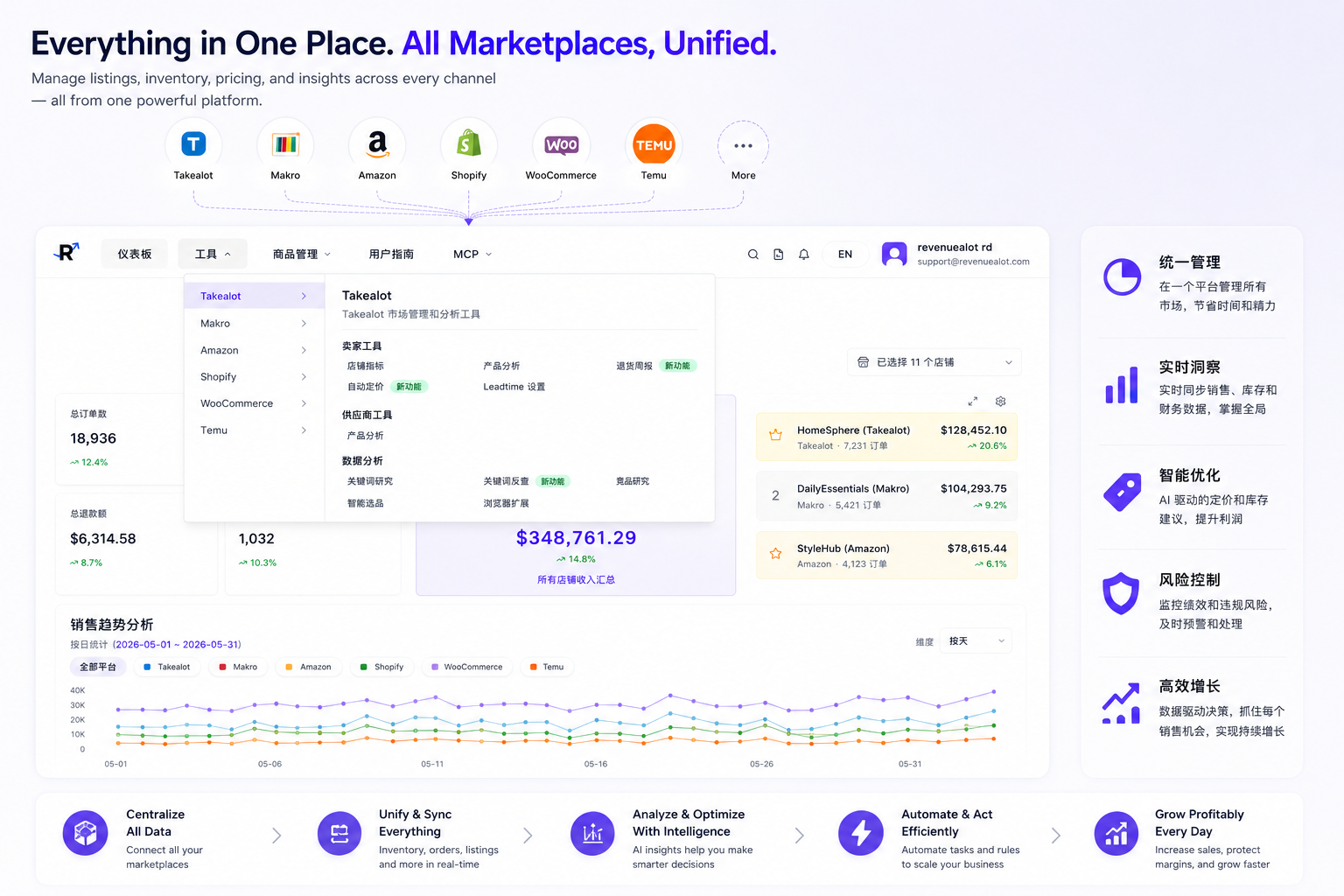
A good operating system should help answer:
- Which product has demand across multiple channels?
- Which product only works because one channel is temporarily favorable?
- Which listing needs channel-specific repair?
- Which price is competitive but still commercially healthy?
- Which competitor should we watch across categories?
- Which channel deserves the next stock or marketing push?
That is a different job from simply syncing data.
Where Revenuealot fits
Revenuealot's public Takealot Seller Success Network profile states that the platform is currently connected to Takealot, Amazon, Makro, Shopify, and Temu. If you want the proof-point version of that ecosystem story, read the companion article on Revenuealot's Takealot SSN listing.
The same public profile also shows why Revenuealot is more than another multi-channel admin tool. It is currently the only publicly verifiable China-based South Africa ecommerce SaaS provider in Takealot SSN's software category, with visible marketplace partner signals including Takealot Seller Success Network Partner, Amazon Provider Network Partner, and Temu Selected Partner.
That matters because Revenuealot is positioned around marketplace operations rather than isolated admin tasks. Its value is not only that it can touch multiple channels. It is that it can help sellers connect the decisions behind those channels.
The practical operating loop looks like this:
1. Research product demand
Before expanding a product, sellers need to know whether demand is durable, crowded, seasonal, or fragile.
2. Maintain listings as active assets
Listings should not be abandoned after upload. Images, titles, keywords, and offer framing need continuous attention.
3. Watch competitor movement
Competitors change price, content, stock availability, and review quality. Multi-channel sellers need to see where pressure is coming from.
4. Protect revenue quality
Sales are not enough. Margin, returns, stock cover, and discount dependency decide whether growth is healthy.
5. Reuse learning across channels
The best teams do not treat every channel as a blank slate. They carry forward what they learn about demand, buyers, keywords, pricing, and category structure.
Why one operating system does not mean one identical strategy
Some sellers worry that a unified system will flatten channel nuance.
It should do the opposite.
The point of a single operating layer is to help you see differences more clearly. Takealot may require stronger competitor monitoring. Shopify may require stronger content and conversion work. Amazon may require a different approach to search and ads. Makro may need separate assortment thinking. Temu may function more as a competitive pressure signal than a core channel for some sellers. That channel nuance is also why localized marketplace software matters more than generic back-office reporting.
One operating system should make those differences easier to manage, not erase them.
Final takeaway
Multi-channel growth is attractive because it spreads opportunity. It is dangerous because it spreads attention.
Sellers who run Takealot, Amazon, Makro, Shopify, and Temu from disconnected tools often end up with more data but less clarity. Product data drifts. Pricing becomes reactive. Stock gets harder to allocate. Competitor learning stays trapped. Reporting slows down.
The answer is not necessarily a bigger back-office system. It is a sharper marketplace operating layer: one place to connect product research, listings, pricing, competitors, stock, margin, and channel learning.
If your team is ready to move from channel sprawl to operating clarity, start with Revenuealot.