Makro Black Friday Selling Strategy: How to Plan Product Selection, Pricing and Inventory
Black Friday can create valuable sales opportunities for sellers on Makro, but a busy shopping period does not automatically translate into higher profits. A product may attract more attention during a promotion, yet the seller can still lose money through excessive discounts, unexpected fulfilment costs, stock shortages, or unsold inventory after the campaign.
I believe the biggest mistake sellers make when preparing for Makro Black Friday is treating it as a discounting exercise rather than an operational planning process. Lowering prices is relatively easy. Knowing which products deserve a discount, how far prices can safely fall, and how much stock to prepare requires a much clearer understanding of the business.
For South African ecommerce sellers, preparation should begin well before Black Friday. Historical sales performance, current market demand, competitor pricing, supplier lead times, and product profitability all influence the decisions that follow.
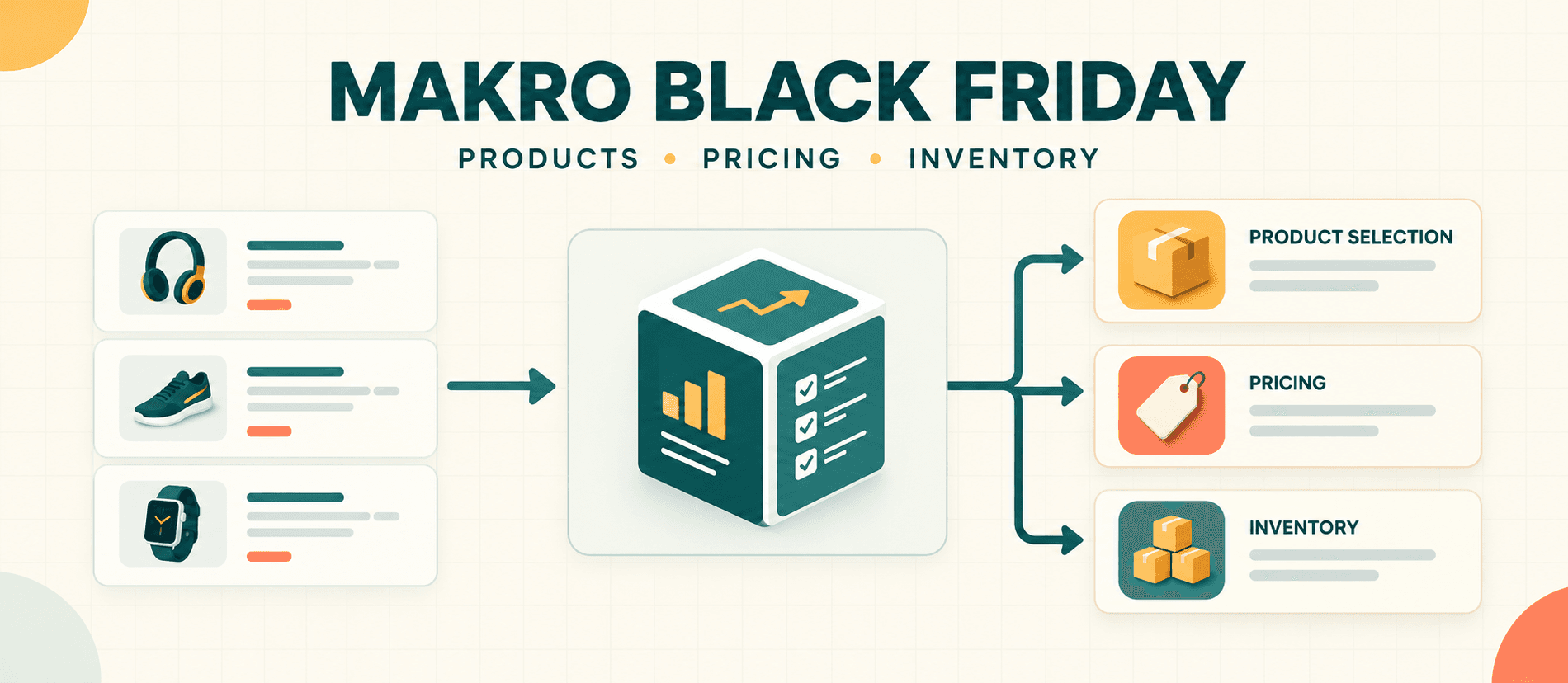
In this guide, I will explain how I would approach Makro Black Friday through three practical areas: product selection, pricing strategy, and inventory planning. I will also discuss how data analytics and ecommerce management tools such as Revenuealot can support better-informed decisions before and during the campaign.
Makro Black Friday Product Selection: How to Find Products Worth Promoting
Choosing the right products is the foundation of a successful Makro Black Friday selling strategy. Not every product in a catalogue deserves a promotional discount, and not every product that appears popular will generate an attractive return.
My approach is to evaluate demand, competition, profitability, and operational readiness together instead of relying on a single sales indicator.
Use Sales Trends and Market Demand to Guide Product Research
The first question I ask is whether there is a reasonable commercial case for promoting a product.
A product with strong historical sales may be worth considering, but I would not automatically assume that its performance will continue during Black Friday. Demand can change with seasonality, customer budgets, competing promotions, and the availability of alternative products.
I would begin by reviewing the information available for each product, including historical sales, revenue, units sold, price changes, and recent performance trends. Where reliable data is available, I would also examine how performance differs between recent periods and the same period previously.
For example, a seller offering small household appliances might compare several products rather than immediately investing heavily in the most popular item. One product may have consistent demand and a stable margin, while another may generate occasional sales spikes but require substantial discounts to compete.
The first product could be a safer promotional candidate, even if the second attracts more attention.
I would also consider whether the product solves a clear customer problem. Practical household items, accessories, and products suitable for seasonal purchasing may deserve investigation, but I would validate each opportunity using actual marketplace evidence rather than assuming an entire category will perform well.
Analyse Competitors Before Choosing Your Black Friday Products
Competition becomes particularly important when multiple sellers offer similar products.
Before committing to a promotion, I would examine competing offers, available price points, product ratings, review counts, listing quality, and visible differences between products. These indicators help explain why one offer might be more attractive than another.
However, I would avoid treating the lowest competitor price as the only benchmark.
A competing product might have different specifications, a stronger review history, a different fulfilment arrangement, or a bundle that offers more value. Comparing the headline prices alone could lead to an unnecessary price reduction.
I would instead ask three questions:
- How many credible alternatives are available to customers?
- What makes my product different from competing offers?
- Can I remain competitive without sacrificing an acceptable profit margin?
This is where marketplace research tools become useful. Revenuealot provides Makro Store Metrics and Product Analytics, helping sellers examine their store performance and product-level metrics. Its broader marketplace research capabilities can also help sellers assess market signals where the relevant tools and data are available.
These insights do not guarantee that a product will succeed during Black Friday. Their value lies in helping sellers replace assumptions with evidence and identify which products deserve further investigation.
Calculate Profit Potential Before Committing to a Promotion
A product should not be selected simply because its selling price looks attractive or its sales volume appears promising.
I would calculate its contribution to profit before deciding how aggressively to promote it.
Consider a hypothetical product with the following figures:
Cost or revenue item | Amount |
|---|---|
Planned selling price | R500 |
Product acquisition cost | R250 |
Estimated marketplace commission | R60 |
Fulfilment and delivery costs | R50 |
Packaging and other variable costs | R20 |
Contribution before other overheads | R120 |
The figures above are illustrative, not Makro's actual fee schedule. Sellers should calculate their own costs using the applicable commission rates, fulfilment charges, storage costs, and other expenses.
In this example, the product contributes R120 before other overheads. If a Black Friday discount reduces the selling price to R400 while the other costs remain unchanged, the contribution falls to R20.
That is a significant reduction in the amount earned from each sale.
I would therefore prioritise products that combine credible demand, a defensible competitive position, sufficient stock availability, and enough margin to support a carefully planned promotion.
The objective is not simply to sell more units. It is to generate profitable sales that the business can fulfil reliably.
Makro Black Friday Pricing Strategy: How to Stay Competitive Without Losing Profit
Pricing is one of the most difficult parts of Makro Black Friday preparation. Sellers want to attract customers, remain competitive, and improve sales, but aggressive discounting can quickly damage profitability.
My preferred approach is to establish pricing boundaries before the campaign begins. This makes it easier to respond to market changes without making rushed decisions.
Calculate Your Minimum Profitable Selling Price
Before setting a Black Friday discount, I would calculate the minimum price that covers all relevant variable costs and leaves the required contribution.
A simplified formula is:
Minimum selling price = Product cost + Variable selling costs + Required contribution
The calculation should include the costs that apply to the specific product and fulfilment arrangement. Depending on the business, these may include marketplace commission, fulfilment, delivery, packaging, storage, payment-related charges, and an allowance for returns or other variable expenses.
For example, suppose a product costs R250 to acquire, with R130 in other variable selling costs. If the seller wants to retain a contribution of at least R70 per unit, the minimum target selling price would be R450.
This is a simplified illustration. Actual pricing calculations may need to account for fees calculated as a percentage of the selling price.
Once I establish the minimum acceptable price, I can evaluate different promotional scenarios without guessing how much discount the business can afford.
I would also distinguish between contribution and net profit. A product that covers its direct costs may still fail to cover salaries, software subscriptions, warehousing overheads, and other fixed expenses.
A discount that appears profitable at product level is not necessarily profitable for the business as a whole.
Monitor Competitor Prices and Respond Strategically
Competitor prices can change quickly during a major sales campaign. However, I would not automatically match every reduction.
Instead, I would compare my offer against relevant competitors and determine whether a price adjustment is justified by the expected commercial benefit.
If a competitor lowers a price slightly, I would first check whether the difference is meaningful to customers and whether my existing offer remains attractive.
If a competitor introduces a substantial discount, I would review the product's margin, stock position, sales trend, and strategic importance before responding.
There may be situations where matching the competitor is reasonable. In others, maintaining the price and improving the listing, offering a more suitable bundle, or prioritising a different product may be the better decision.
For sellers managing multiple products, this process can become difficult to maintain manually.
Revenuealot's Makro Store Metrics and Product Analytics can help sellers review store and product performance. Its broader platform also supports marketplace research and operational management, allowing teams to bring relevant information into a more structured workflow.
I would use these insights alongside current marketplace offers and my own cost calculations. I would not assume that any tool can guarantee a Buy Box win or predict a competitor's next price change with certainty.
Build a Discount Strategy Around Your Business Goals
Not every product needs the same promotional approach.
I would group products according to their purpose in the Black Friday campaign.
Product group | Suggested approach | Main consideration |
|---|---|---|
Established bestsellers | Consider a controlled discount | Protect contribution while supporting sales volume |
Products with strong margins | Evaluate deeper discounts where justified | Ensure the final price remains commercially viable |
Slow-moving stock | Consider selective clearance | Compare the discount cost with the cost of holding inventory |
New or unproven products | Use cautious promotions | Avoid committing excessive stock before demand is established |
This framework helps sellers avoid blanket discounting across the entire catalogue.
I would also review promotional claims carefully. Makro Marketplace's promotion pricing guidance emphasises fair and accurate promotional messaging, including the need for genuine reference prices. Sellers should check the latest applicable policy before advertising a discount.
Finally, I would define clear pricing rules before the campaign: the target selling price, minimum acceptable price, expected contribution, and conditions that justify a price change.
A structured approach reduces the risk of making decisions based on competitor pressure alone.
Makro Black Friday Inventory Planning: How to Avoid Stockouts and Overstocking
Even a well-priced product can underperform if the seller cannot fulfil orders. On the other hand, excessive purchasing can leave the business holding stock long after Black Friday has ended.
I would therefore treat inventory planning as a balance between expected demand, supplier reliability, available working capital, and the time required to replenish stock.
Estimate Demand and Prepare Stock in Advance
I would begin with the sales history of each product, paying particular attention to recent performance and any comparable promotional periods for which reliable records exist.
Historical sales can provide a starting point, but Black Friday demand should not be estimated by simply multiplying normal sales by an arbitrary percentage.
Instead, I would consider several factors: current sales trends, the planned discount, competitor activity, product availability, seasonality, and the seller's ability to replenish inventory.
A basic stock-planning formula is:
Required stock = Expected sales during the planning period + Safety stock − Available stock − Confirmed incoming stock
For example, suppose I expect to sell 150 units during the campaign, want a safety buffer of 30 units, currently have 60 available units, and have 40 confirmed incoming units that will arrive in time.
My additional stock requirement would be:
150 + 30 − 60 − 40 = 80 units
This is a planning example rather than a demand forecast. The result depends on the accuracy of the sales estimate and whether incoming stock will genuinely be available before demand peaks.
I would also account for supplier lead times. Stock arriving after the main promotional period may not solve a shortage during the campaign.
Where supplier delivery times are uncertain, I would use a more conservative estimate and prioritise products with reliable replenishment.
Set Inventory Priorities for Different Product Types
I would not allocate inventory equally across every product.
Products with stable demand, proven profitability, and dependable supply may justify a higher stock commitment. Products with uncertain demand or thin margins should receive more cautious allocations.
I would also consider the cost of holding unsold inventory after the campaign. A product that requires substantial storage space or ties up significant working capital may be riskier than a smaller, easier-to-replenish item.
My inventory plan would identify which products need early replenishment, which can be restocked quickly, and which should have purchasing limits.
For each priority product, I would record the available quantity, expected sales, supplier lead time, confirmed incoming stock, and the date by which additional stock must be ready.
I would then review these figures regularly as Black Friday approaches.
Makro sellers should also check the campaign-specific fulfilment instructions and stock submission deadlines. If a promotion requires inventory to be delivered to a designated fulfilment centre, the planning process must account for those requirements rather than relying only on the seller's warehouse balance.
Use Sales Data to Improve Stock Decisions Across Channels
Inventory planning becomes more complicated when the same products are sold through several marketplaces.
Stock allocated to Makro may also be needed to fulfil orders from Takealot, Amazon, or another sales channel. Without a clear view of available and committed inventory, a seller may overestimate the quantity available for a Black Friday promotion.
I would therefore review stock commitments across the business before finalising Makro quantities.
Revenuealot is designed to support South African ecommerce operations across authorised marketplace accounts. Depending on the connected stores and available plan features, sellers can use its operational workspace to manage marketplace information and product listings, while relevant analytics help them review performance.
Its multi-marketplace listing management capabilities can also help teams manage listings across supported channels from a more centralised workflow. This is particularly relevant to sellers expanding beyond Makro who want to reduce repetitive product-management tasks.
However, listing management and inventory forecasting are not the same thing. Sellers should verify the inventory data and workflows available for their specific setup, maintain accurate stock records, and confirm that inventory updates are working as intended.
I would also establish a simple campaign monitoring routine. During the promotional period, I would review sales velocity, remaining stock, contribution, fulfilment issues, and any unexpected changes in demand.
If a product sells faster than expected, I would assess whether replenishment is possible before accepting additional promotional commitments. If sales are slower than expected, I would review the price, product page, competing offers, and demand assumptions before purchasing more inventory.
The goal is to make adjustments based on current evidence rather than waiting until the campaign ends.
Conclusion: Build a More Disciplined Makro Black Friday Plan
A successful Makro Black Friday strategy starts before the first discount goes live.
I would select products using demand and competition evidence, establish minimum acceptable prices before changing offers, and prepare inventory around realistic sales expectations and supplier lead times.
I would also review the results throughout the campaign rather than judging success by revenue alone. Units sold, contribution, stock availability, fulfilment performance, and the amount of inventory remaining after the event all help explain whether the campaign delivered sustainable value.
For sellers managing several products or marketplace accounts, Revenuealot can support this process through Makro store and product analytics, marketplace research capabilities, and multi-platform management workflows where available.
The key is to use data as an input to better decisions, not as a substitute for commercial judgement. Black Friday can create opportunities, but disciplined product selection, pricing, and inventory planning determine how much value a seller actually retains.
FAQ: Makro Black Friday Selling Questions
1. When should Makro sellers start preparing for Black Friday?
I would begin several weeks or months in advance, depending on supplier lead times and campaign requirements. Product selection, margin calculations, supplier orders, listing checks, and any required promotional submissions should be completed early enough to resolve problems before the campaign.
2. How do I choose the best products for Makro Black Friday?
I would evaluate historical sales trends, market demand, competitor offers, product differentiation, variable costs, and available stock. A promising product should have a credible demand case and enough margin to support a promotion without creating an unacceptable financial risk.
3. Should I lower my prices to match competitors on Makro?
Not automatically. First, I would calculate the minimum acceptable price and assess how the competing offer compares with my own product. If matching the price would undermine profitability, maintaining the price or adjusting the promotional strategy may be more appropriate.
4. How much stock should I prepare for Makro Black Friday?
I would estimate campaign demand, add an appropriate safety buffer, and subtract available inventory and confirmed incoming stock that will arrive in time. The final quantity should also reflect supplier reliability, working capital, storage costs, and campaign-specific fulfilment requirements.
5. How can Revenuealot help Makro sellers prepare for Black Friday?
Revenuealot provides Makro Store Metrics and Product Analytics to help sellers review store performance and product-level data. Its broader platform includes marketplace research and multi-marketplace listing management capabilities for supported channels and plans. These tools can support product evaluation and operational planning, but sellers remain responsible for validating forecasts, calculating margins, and making final pricing and inventory decisions.