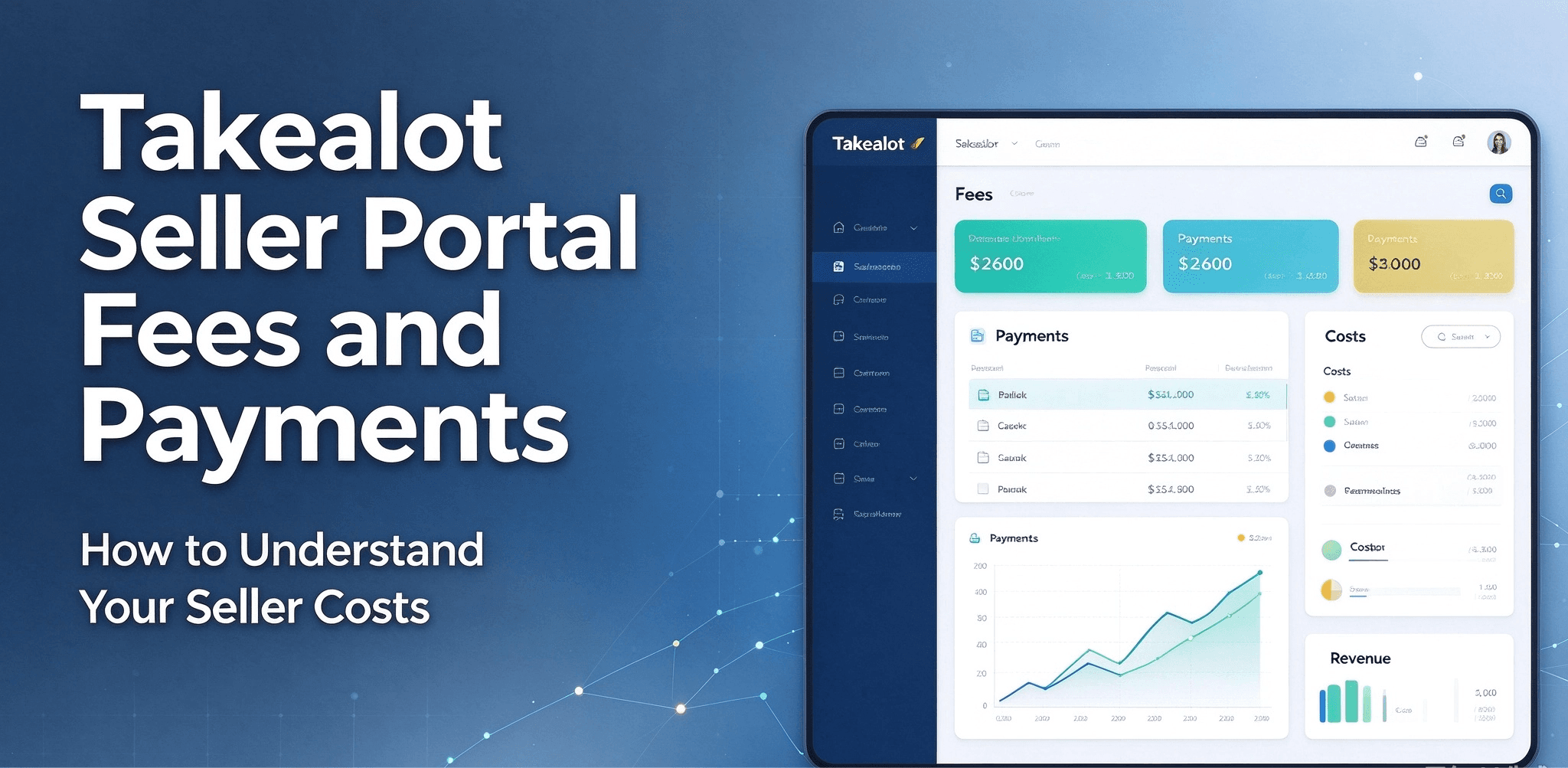
Takealot Seller Portal Fees and Payments:How to Understand Your Seller Costs
Selling on Takealot can give my business access to South African online shoppers, but strong sales figures do not automatically translate into strong profits. I might sell 100 units in a month and feel that business is moving in the right direction, only to discover that fulfilment fees, platform commission, storage charges and other operating expenses have left me with a much smaller margin than expected.
This is one of the most important lessons I have learned when evaluating marketplace performance: sales revenue, Takealot payouts and actual business profit are three different things.
The Takealot Seller Portal provides the essential environment for managing seller operations, while Takealot's fee structure determines how much of each sale remains after marketplace charges. Understanding both is crucial for pricing products correctly, planning inventory and maintaining healthy cash flow.
In this guide, I will explain the main Takealot seller fees, how the payment process works, and how I approach cost management using sales data. I will also explain how Revenuealot can complement the Seller Portal with product analytics, performance tracking and tools for managing marketplace operations.
Fee note: The figures and rules below reflect publicly available information checked on 23 October 2026.Takealot can update its rates and policies, so sellers should confirm the charges applicable to their accounts before making financial decisions.
Takealot Seller Portal Fees:What Costs Should Sellers Budget For?
Before I list a product on Takealot, I calculate more than its purchase cost and selling price. I also consider marketplace commission, fulfilment, storage and the expenses associated with keeping inventory available to customers.
Takealot's official seller information identifies a monthly subscription fee, success fees, fulfilment fees and storage fees as key components of its marketplace pricing. The published monthly subscription is R400 per seller account, excluding VAT.
Takealot Monthly Subscription Fee and Success Fee Explained
The monthly subscription is a fixed operating expense. Unlike a commission charged on an individual sale, it does not automatically decrease when sales are slow. This makes it particularly important for new sellers who have not yet established consistent demand.
The success fee is Takealot's commission on sales. The applicable rate depends on the product category and the relevant fee terms. A September 2026 guide from Netcash reports category-based rates commonly ranging from 4% to 15%, although this should not be treated as a universal rate for every product. Sellers should check their current category-specific charges using Takealot's official fee information and estimator.
For example, a low-priced item can look attractive because it sells frequently, but a percentage-based commission combined with a per-item fulfilment charge can consume a substantial portion of its available margin.
I therefore separate my Takealot costs into two groups:
Cost type | How I account for it |
|---|---|
Monthly subscription | Allocate the fixed fee across a realistic number of monthly sales. |
Success fee | Calculate the applicable category-based commission for each product. |
Fulfilment fee | Check the charge applicable to the product's size, weight and fulfilment arrangement. |
Storage fee | Estimate the cost of holding inventory beyond the applicable free stock-cover threshold. |
Other operating expenses | Include sourcing, inbound transport, packaging where applicable, advertising, returns and relevant taxes. |
This breakdown makes it easier to identify products that generate impressive sales but contribute very little to the business.
Takealot Fulfilment Fees:How Product Size and Weight Affect Costs
Fulfilment costs deserve particular attention because they can vary significantly between products. A compact accessory and a bulky household product do not necessarily have comparable handling and delivery costs, even when their selling prices are similar.
Takealot's fulfilment fees depend on applicable product size and weight bands. A March 2026 platform update reproduced by Huiguang ERP reported a 7% fulfilment-fee increase effective 1 April 2026 across size and weight bands. The update also explained that the applicable fee is determined when the item is shipped from a distribution centre, meaning an order placed before the effective date could still attract the new fee if shipped afterwards.
This is why I would not rely on an old spreadsheet or a competitor's fee estimate when pricing a new product.
Instead, I check the current fee estimate for the specific product and model the likely cost at its intended selling price. If I am considering a product with several variations, I also check whether their physical dimensions and weights could place them in different fulfilment bands.
A product with a healthy gross margin before fulfilment may become much less attractive after logistics costs are included. I would rather identify that problem before ordering a large quantity than discover it after the stock has reached the warehouse.
Takealot Storage Fees and the 35-Day Stock Cover Threshold
Storage costs become especially relevant when I hold stock at Takealot distribution centres. Inventory that sells consistently is generally easier to manage than inventory that remains in storage without generating enough sales to justify the space it occupies.
Under the storage structure effective 1 June 2026, Takealot charges storage fees on units exceeding the 35-day stock-cover threshold, rather than charging the entire on-hand quantity simply because the threshold has been crossed. The per-unit charge depends on the product's size category.
I calculate stock days cover using this formula:
Stock days cover = Current stock ÷ Average daily sales over the last 30 days
Suppose I have 400 units of a product in stock, and the product has averaged 10 sales per day over the last 30 days.
My stock cover is 40 days. At a 35-day threshold, the corresponding stock quantity is 350 units, leaving 50 units above that threshold.
For a product in the Small storage category, the published revised rate is R4 per eligible excess unit per month. In this hypothetical example, 50 excess units would produce a storage charge of R200, excluding VAT, assuming the stated category and stock figures apply.Other size categories carry different rates, so I always verify the appropriate band before forecasting the expense.
This calculation changes how I approach replenishment. I do not simply ask whether a product is selling. I ask whether its sales rate supports the quantity I intend to keep in storage.
Other Business Costs That Affect Your Takealot Profit Margin
Takealot's marketplace charges are only part of the total cost of doing business. Depending on the product and business model, I also need to consider supplier costs, inbound freight, import-related costs, advertising, returns and taxes.
These expenses are particularly important for sellers operating on narrow margins. A product can remain profitable after marketplace deductions but still deliver disappointing results once the entire operating cost is included.
My approach is to build a product-level cost model before committing to inventory. I use the official Takealot fee estimator to understand applicable marketplace charges, then add the business expenses that sit outside those charges.
The objective is not simply to find the lowest-cost product. It is to identify products that can deliver a sustainable contribution after realistic costs, even when competition forces me to adjust the selling price.
Takealot Seller Portal Payments: How to Understand Your Payouts
Understanding the fee structure tells me what a sale costs. Understanding payments tells me when the resulting cash may become available to the business.
Takealot advertises direct payments to sellers four times per month. However, I would not plan working capital around the assumption that every order immediately becomes a bank deposit. Sales activity, marketplace deductions, account balances and the applicable disbursement process all need to be considered.
Takealot Seller Payment Schedule and Disbursement Process
When I review my Takealot payment information, I distinguish between three figures: total sales, the balance recorded in the marketplace account and the amount actually paid into the business bank account.
These figures serve different purposes.
Total sales show the value of transactions generated during a period. The marketplace balance reflects the account's recorded transactions and adjustments. A bank payout represents the funds disbursed to the seller.
The difference matters because selling fees, refunds and other account adjustments can affect the amount ultimately available for payment.
I therefore use the Seller Portal and the applicable account statements to verify the exact disbursement schedule and amount. This is particularly important when opening a new seller account or when planning around a large stock purchase.
For cash flow planning, I also separate expected future sales from funds already available. I may have products selling well today but still need working capital to purchase replacement stock, pay suppliers and cover inbound freight before the next payment arrives.
How to Read Transactions,Fees,Refunds and Your Net Balance
The Seller Portal's transaction information is an important reference when I investigate why the money received differs from my headline sales figures.
Rather than treating a payout as a single unexplained number, I reconcile the underlying activity. I compare sales transactions with marketplace charges, refunds and other applicable adjustments, then check whether the resulting balance matches the relevant statement and bank deposit.
For example, a lower-than-expected payout does not automatically mean that sales were recorded incorrectly. It could reflect fee deductions, customer refunds, adjustments or differences between the reporting period and the payment period.
My reconciliation process follows a simple sequence:
- Check the sales transactions for the relevant period.
- Match the associated success and fulfilment fees against the applicable charges.
- Review refunds and other adjustments.
- Compare the resulting account balance with the payout information.
- Investigate any unexplained differences using the detailed transaction records.
I keep these records even when the amounts appear small. Repeated discrepancies or overlooked charges can become material as sales volumes increase.
I also avoid confusing marketplace reporting with accounting treatment. If my business is VAT-registered, I need to account for VAT correctly rather than assuming that every rand shown as sales revenue is available to spend.
My accountant or tax adviser can help ensure that the business's accounting records properly reflect its circumstances.、
Cash Flow Management for Takealot Sellers
Good sales performance does not remove the need for a cash flow plan. In some cases, faster sales can create additional pressure because I must replenish inventory before my available funds have caught up with demand.
I therefore forecast three things together: expected sales, operating expenses and upcoming stock commitments.
For instance, if a product is selling faster than expected, I estimate how much cash will be needed to reorder it and when that payment must be made. I then compare the requirement with current bank funds and realistic expected marketplace disbursements.
I also leave room for less favourable outcomes, including slower sales, a higher return rate or additional storage costs. This prevents me from treating an optimistic sales forecast as guaranteed cash.
For growing sellers, this discipline becomes increasingly important when managing several product categories or operating across multiple marketplace accounts.
The goal is to maintain enough working capital to keep profitable products available without allowing slow-moving stock to consume resources unnecessarily.
Takealot Seller Portal Data: How to Control Costs and Protect Your Margins
Once I understand the fee structure and payment process, I use that knowledge to improve operating decisions. The key is to connect sales performance with product costs, pricing and inventory rather than looking at each metric independently.
Calculate Your Real Profit Per Product Before Changing Prices
Before adjusting a selling price, I estimate the contribution generated by each product.
A practical model is:
Product contribution = Net sales revenue − Product costs − Applicable marketplace fees − Other variable operating costs
The model should also reflect the business's VAT treatment and any additional expenses relevant to the product. I keep the monthly subscription and other fixed expenses visible separately, then allocate them when assessing overall profitability.
This is useful when deciding whether a price reduction is sustainable. A discount might increase sales volume, but if the additional volume does not compensate for the reduction in contribution per unit, the promotion may not improve the business's overall position.
I also compare products within the same category. One product might generate more revenue, while another delivers a healthier contribution after its sourcing, fulfilment and advertising costs.
For this reason, I avoid treating revenue rankings as automatic profit rankings. I want to understand which products are driving growth, which are consuming too much working capital and which deserve further investigation.
Use Sales Analytics and Stock Data to Reduce Unnecessary Costs
Sales history helps me assess whether my inventory decisions are supported by actual demand. I look for changes in sales trends, products losing momentum and items whose stock levels are growing faster than their sales.
This gives me a more informed basis for adjusting replenishment. A product with increasing demand may justify additional stock, while a product approaching the 35-day stock-cover threshold may need a closer review of purchasing plans and sales performance.
This is also where I can distinguish between a pricing problem and an inventory problem. A product may be selling slowly because its price is uncompetitive, because demand has weakened or because its listing needs attention. Those possibilities call for different responses.
I would not automatically discount every slow-moving product. Instead, I first assess competitor pricing, recent sales, available inventory and the product's contribution. I then decide whether a price change, better listing information or a reduction in future replenishment is the more appropriate action.
The same approach applies to advertising. Increased advertising expenditure is worth examining against the sales and contribution it helps generate, rather than judging campaigns solely by clicks or total revenue.
How Revenuealot Supports Takealot Sellers With Analytics and Multi-Platform Operations
For sellers who need a clearer view of their marketplace performance, Revenuealot provides an additional layer of analytics and operational support.
Revenuealot is a South African ecommerce management SaaS platform that supports authorised marketplace accounts, including Takealot, Amazon and Makro, with additional workflows available for other supported channels. Its published tools include Takealot Store Metrics, Product Analytics, Ads Analytics, competitor research and automated pricing capabilities.
I see three particularly relevant applications for sellers managing their costs.
First, Store Metrics and Product Analytics help sellers examine sales performance, product-level trends and relevant return metrics. These insights can support decisions about which products deserve further investment and which need a closer review.
Second, Ads Analytics helps sellers assess advertising performance, including spend, revenue and return on advertising investment. This is useful when reviewing whether a campaign appears to be generating value rather than merely increasing activity.
Third, multi-platform management and listing tools can help businesses operating across supported channels organise product information and reduce repetitive administrative work. Revenuealot also offers tools for competitor research and automated pricing, subject to the relevant features and plan.
These capabilities are especially relevant when a seller is expanding beyond one Takealot account or trying to make decisions across several marketplaces.
There is, however, an important distinction I maintain: Revenuealot's analytics are not a substitute for Takealot's official transaction statements, fee estimator or payment records. For a precise payout reconciliation, I use the original marketplace records as the source of truth. I use Revenuealot to help interpret performance data and improve the operational decisions that influence future results.
My recommended workflow is straightforward. I begin with the official fee information, calculate a realistic cost model for each product, monitor actual performance, and then use sales and product analytics to identify where pricing, advertising or inventory decisions deserve attention.
The result is a more consistent way to manage costs: rather than reacting to the latest payout, I look at the operating factors that determine whether my Takealot business is sustainable.
Takealot Seller Portal Fees and Payments: FAQs
1. How much does it cost to sell on Takealot?
Takealot's publicly listed monthly subscription is R400 per seller account, excluding VAT. Sellers must also budget for applicable success fees, fulfilment fees and storage charges, as well as their own product and operating expenses. The total cost depends on the products sold and the seller's operating model. Always confirm current fees before listing.
2. How often does Takealot pay its sellers?
Takealot's public seller page advertises payments directly to sellers four times per month. The precise amount and timing for an individual account should be checked against the current Seller Portal and applicable payment records.
3. Why is my Takealot payout lower than my total sales?
Your payout may reflect success fees, fulfilment charges, refunds and other account adjustments rather than total sales alone. Differences in reporting and payment periods can also affect comparisons. Reconcile the transactions, account balance and bank deposit before concluding that there is an error.
4. How can I reduce Takealot storage and fulfilment costs?
I recommend starting with accurate product dimensions and weight, realistic pricing, and inventory quantities aligned with recent demand. Monitor stock days cover, particularly around the 35-day storage threshold, and investigate slow-moving stock before ordering more. Check the current official fee schedule when evaluating any change in product packaging or fulfilment arrangements.
5. Can Revenuealot help me analyse my Takealot sales and profitability?
Revenuealot offers Takealot Store Metrics, Product Analytics, Ads Analytics and other marketplace research and management tools. These can help sellers assess sales trends, product performance, advertising results and competitive conditions. For exact platform charges and payout reconciliation, continue using Takealot's official account records and fee tools alongside those analytics.
Final takeaway:I treat Takealot fees, marketplace payments and product profitability as connected but separate parts of running an ecommerce business. Once I understand what each sale costs, reconcile what the marketplace pays and use reliable performance data to guide pricing and inventory, I can make decisions based on actual business economics rather than sales revenue alone.